YERKON A terrestrial positioning backup layer Run the simulation

YERKON

YERKON is a proposal for road transport to depend less on foreign satellites for position. A cheap broadcast unit goes onto masts and cabinets already standing by the road, and the receiver in a vehicle finds where it is by measuring its distance to the units around it.
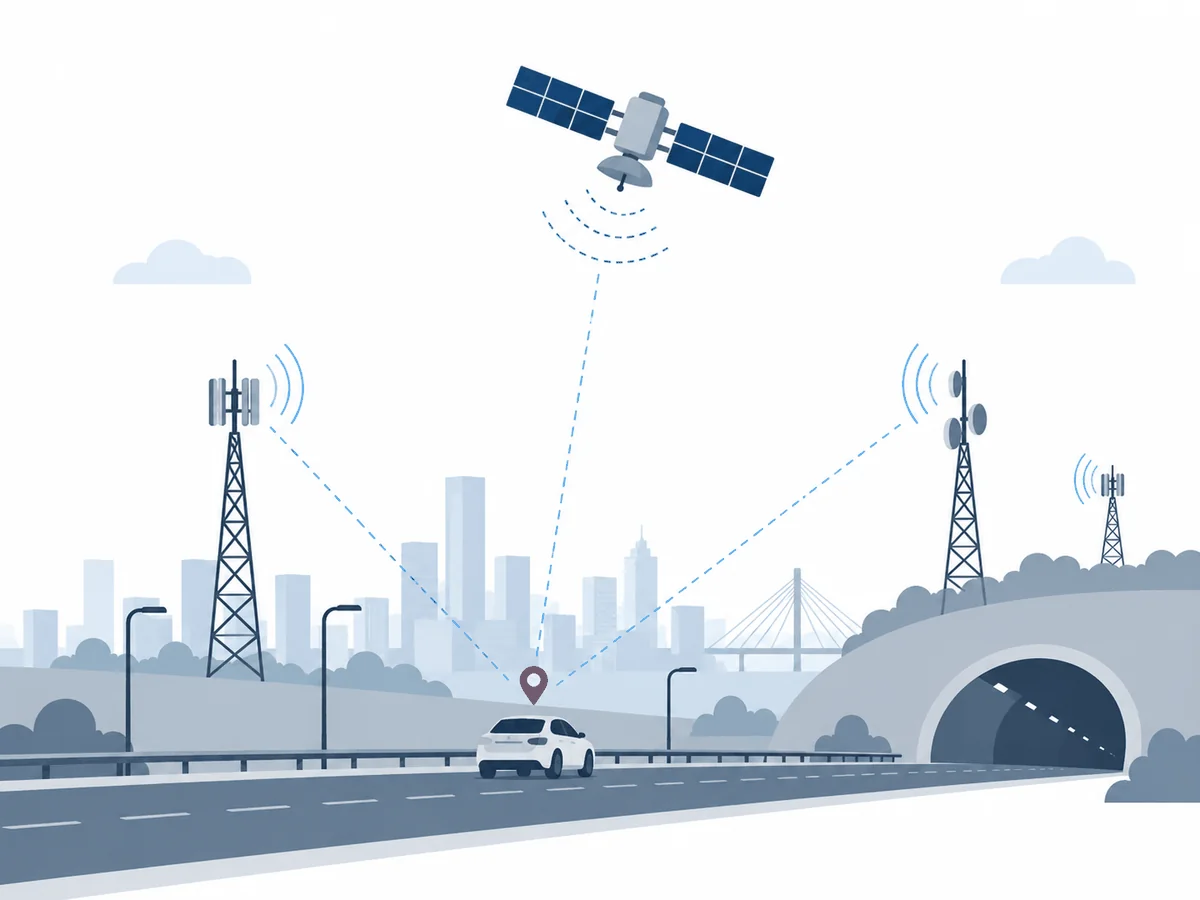
From the report. The broadcast units go onto points already standing by the road. A receiver sees both the satellites and the units on the ground, and carries on with the ground ones when the satellites go.

What it proposes

The Ministry of Transport and Infrastructure already has points on the power and communications network: intelligent transport cabinets, roadside units, traffic lights, tunnel lighting and toll gates. YERKON adds a low cost radio broadcast unit to those points. The unit broadcasts its identity and the position surveyed when it was installed. Where those points are sparse, the other poles along the road are used: in the simulation, lighting columns in town and mostly electricity distribution poles in open country.

A broadcast unit costs roughly 1400 to 1700 lira at a thousand units, box, printed board and assembly included. The aim is to reuse the power and communications already standing at intelligent transport points, and that is what keeps the cost down.

YERKON does not aim to replace the satellites. While they work, the two positions sit side by side, and comparing them can help detect a spoofing attack.

9,19 mUrban
8,15 mRural
2,43 mTunnel

The three rows the simulation filled. Each shows the horizontal error that 95 per cent of the measurements stayed under, and each was run over real ground near Ankara.

Pages

The problemNearly everything that finds a position, gives directions or keeps precise time today runs on GPS, Galileo, GLONASS and BeiDou. The dependency does not stop at vehicle navigation: emergency crews, public fleets, telephone networks, the electrical grid and freight all hang on the same four systems.The systemThree parts: broadcast units standing at surveyed positions, receivers that work out their own position, and a management system that keeps the identities current.ResearchThe project is looking for answers to four questions. None of them is closed, and under each one is what will be done.What it is forSo that transport and communications do not stop where position is vital and the satellite signal is cut, weakened or no longer trusted; how it is commercialised closes the page.ResultsThirteen systems side by side under the same columns. The three shaded rows are the YERKON rows the simulation filled; the rest are what their own sources publish. What was done to a cell is in the box the button at the end of its row opens and in the notes at the foot of the page, and an empty cell means the source publishes nothing that fits that column.CostEvery cost cell in the table, line by line: which part, for how much, from whom; which figure, resting on what. The numbers on this page are worked out from the model and the parts list, so when one changes the page does too. Only the pole price table is copied from its sources.RegulationThe rules that set YERKON's power, its route to market and its maintenance cost, with their official sources. Every limit on power, maintenance and rent written here is the one the model uses; the frequency rules for the prototype devices are for the field trials.The simulationThe simulation is one part of this project rather than the whole of it. It had one job: to fill the three YERKON rows of the comparison table with a model whose every number can be traced, instead of with an estimate. It is not a field measurement. The placements are there to show cost feasibility; with more units, or units elsewhere, the accuracy wanted can be had where it is wanted.SourcesEvery number here rests on one of six kinds of thing: a published price or datasheet, a measurement, a standard or regulation, a calculation from sourced figures, a design choice, or an assumption written down.